A puppeteer's guide
Getting Started
Whether this is your first puppet play or your fiftieth, this page covers the basics that apply to every script.
Why we do this
Puppet plays can be a lot of fun, and they can be wonderfully entertaining — but that isn't the point. They're a tool to obey the Great Commission: to share the truth about Jesus and encourage people to follow Him. Keep that at the center and everything else falls into place.
You'll know pretty quickly if someone is in it for their own "glory." The only way for a play to truly fail is for the audience to miss the message of the gospel — so guard that above polish, above performance, above getting every line perfect.
Be sensitive to what your audience can receive. With very young children, go gently on frightening topics like death and jealousy. Whenever you can, use the plays inside a larger setting of teaching and community, and add music that reinforces the story so people remember it and connect it to their own lives.
Before you begin
Pray before you start. This is the most important preparation there is.
Rehearse if you possibly can. Even one run-through makes a big difference.
Read the Bible story ahead of time — even a day before — if the schedule allows. It primes the audience for what's coming.
Have someone hold the script so the puppeteers can move freely.
You don't need a stage or a theater to start. A tabletop works beautifully — pull up chairs, set the script and puppets on the table, and go. The audience will mostly tune the puppeteers out once the play begins. No table? Have two people stretch a sheet or tablecloth between them and let the puppeteers sit behind it. Just make sure the script is secure on a chair or table where it won't slide.
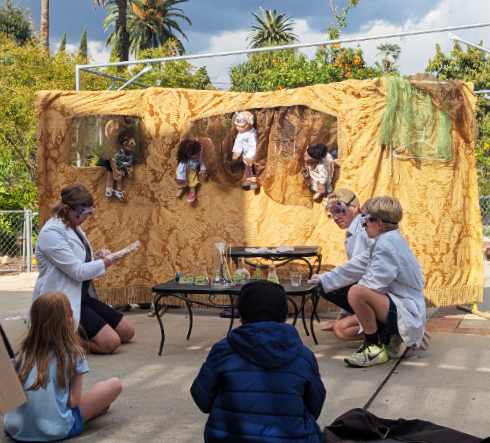
Young puppeteers in lab coats performing Formula for a Christian — outdoors in the backyard, no stage required.
Speaking clearly
Slow down and say every consonant. In normal conversation we slur our endings — "I'm gonna go" instead of "I'm going to go." A puppeteer has to slow down enough that each consonant lands clearly. If someone is racing, be brave and interrupt the play. You're there to disciple and teach the puppeteers too. Don't worry about breaking things up.
Project. You're not shouting, but you do need to be louder than normal. A trick that works: put two people at opposite ends of a large room and have them ask each other questions. Or simply tell your puppeteers to make sure the shy child at the very back hears every single word. If someone is too quiet mid-play, stop and encourage them to speak up.
Pause for laughter. When the audience bursts out laughing, stop and wait patiently until they settle. If they're still buzzing, they'll miss the next line — and the next line might be the one that matters most.
Bringing your puppet to life
During the play, you are your puppet and your puppet is YOU. Let your imagination help you identify with whatever your puppet is saying, and react to whatever the other puppets are doing. Be sad, happy, confused, angry — let your voice carry the emotion.
Quiet or supporting characters and animals stay alive too: nodding, shaking their heads, dropping their jaws, reacting as if they understand. That reaction helps the audience catch what matters. Stay alert, awake, and focused on the story. Never let a puppet sag as if it's asleep or dead, and never pull focus from the main action unless the script asks for it.
Think about who your puppet is. Old? Young? Shy? Bossy? Tough? Don't worry about putting on a funny accent — just imagine you really are that person or animal. And if your puppet learns something important by the end, let that change show. Emphasize the transformation that comes from meeting the truth about Jesus.
If you are the leader of the team and a puppeteer is misbehaving, gently interrupt and set things right before going on. Be authoritative, not authoritarian — firm and kind.

Working from the script
The first time you share a play, stick to the script. Keep your eyes on the page rather than on the other puppeteers, and watch for the stage directions in italics and (parentheses) — those are for you, not to be read aloud. Watch for words in UPPER CASE; they tell you what to emphasize or exaggerate. And keep slowing yourself down.
Some puppeteers like to print the play, clip it into a 3-ring binder, and add tabs for easy page turns. Others prefer it on a device. Either way, make sure it's secure and easy to advance page to page.
After the play
If you have time, ask the audience a few questions afterward — it helps the story stick. Keep them simple and tied to what just happened. Each script offers a few suggested questions of its own to get you started.
A note for the helper out front
It helps to have one person standing where they can see the whole theater — someone with a gentle sense of humor who can step in if something really needs fixing. Adjustments mid-play are normal and nothing to be embarrassed about. Just let the audience in on it: "Oops, let me switch the puppy to my other hand!" or "Can someone help me put the vines back up? Thanks!" It keeps things warm and human.
More guides are on the way: a portable PVC theater build, costume patterns for Bible tunics, and a guide to sound effects.
Ready to pick a script?
Browse the full library — free to download and perform.